

Your Nervous System Isn’t Broken: Understanding Polyvagal Theory in Midlife
In last week’s post, we explored why so many women are diagnosed with ADHD in midlife. And while understanding ADHD can bring a sense of relief, insight alone doesn’t calm a nervous system.
Knowing why something is happening doesn’t automatically change how your body feels.
So this week, we’re going deeper; into how to recognize where your nervous system is operating and how to gently begin shifting toward regulation.
In This Post, You’ll Learn:
- What Polyvagal Theory explains (in simple terms)
- Why perimenopause makes nervous system shifts more intense
- How ADHD and chronic stress amplify fight, flight, and freeze
- Why regulation is different from relaxation
- What gentle nervous system support looks like in midlife
Polyvagal Theory explains how the nervous system moves between three states: safety (ventral vagal), stress (fight or flight), and shutdown (freeze). These shifts are automatic and protective, not personality traits or character flaws.

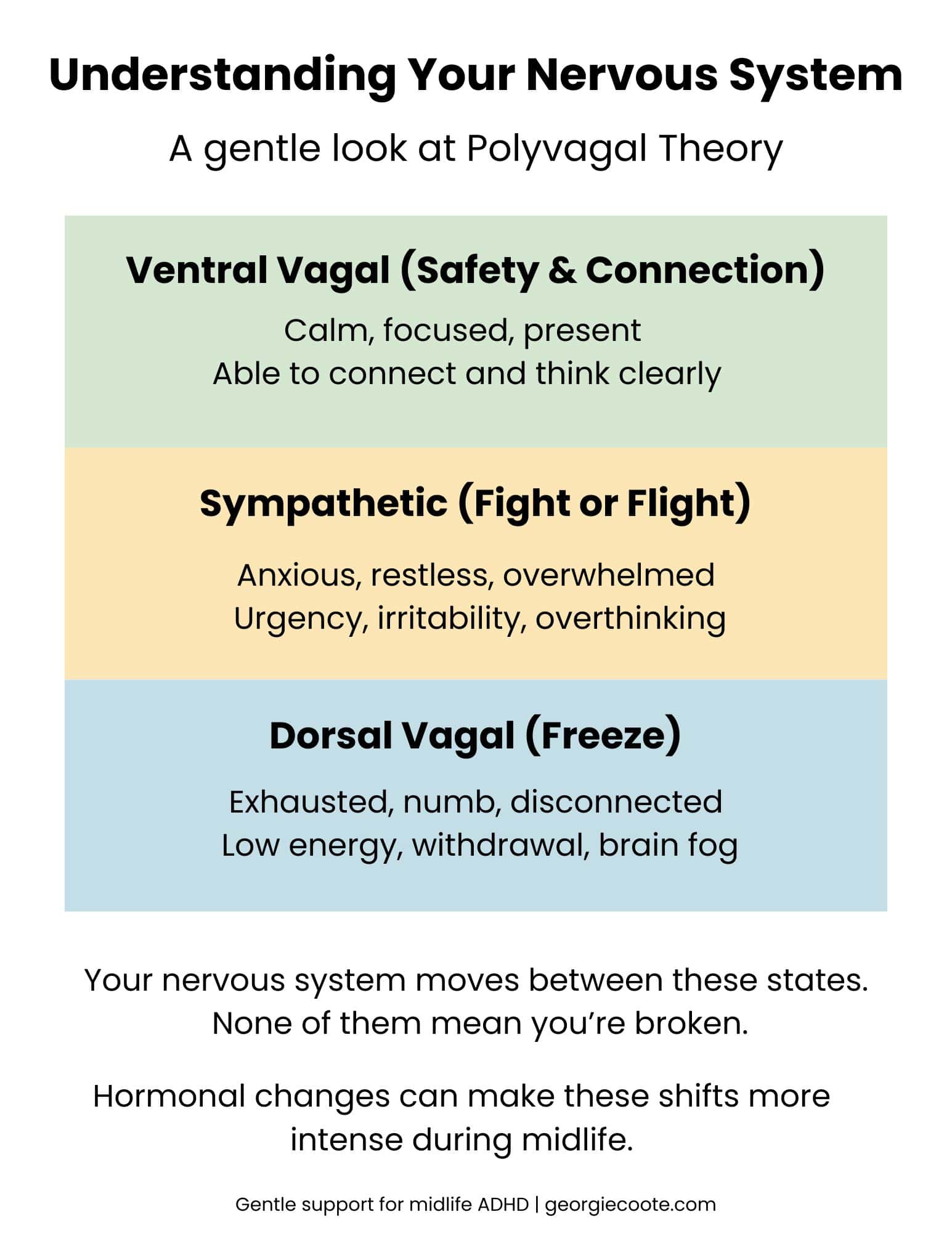
What Polyvagal Theory Explains Simply
Every day, we move between three states: safety, stress, and shutdown.
In a regulated system, we shift fluidly between them. Activation helps us perform when needed, and recovery helps us return to calm.
A surge of adrenaline can help you avoid danger or prepare for a presentation. Temporary collapse after a hard day helps you recalibrate.
The issue isn’t movement between states.
The issue is getting stuck.
When we stay in fight-or-flight too long, anxious, alert, pushing, we forget what calm feels like.
When we stay in shutdown, exhausted, foggy, and unmotivated, it becomes difficult to restart.
That’s not a weakness. It’s nervous system fatigue.
Why Perimenopause Makes Nervous System Shifts More Intense
During perimenopause, fluctuating estrogen can reduce stress buffering in the brain, making the nervous system more reactive and slower to recover.
In perimenopause:
- Hormones begin to fluctuate.
- Sleep becomes disrupted.
- Energy drops.
- Brain fog appears.
And instead of adjusting expectations, many women try to push harder to regain equilibrium.
But the buffering system has changed.
- Estrogen interacts with the stress response
- Sleep disruption increases reactivity
- Cognitive load compounds stress
- Decades of masking increase nervous system fatigue
You may have worked hard to stay capable and organized for decades. Now you’re nearing burnout.
Your nervous system isn’t failing.
It’s signaling overload.
ADHD and the Nervous System
ADHD affects regulation as much as attention, which means midlife hormonal shifts can amplify emotional intensity, overwhelm, and shutdown responses.
-
Emotional intensity reflects sensitivity to input
-
Executive dysfunction increases stress loops
-
Hormonal shifts remove previous coping scaffolding
When ADHD, midlife hormone changes, and long-term stress converge, the system works harder than ever.
This is why symptoms feel amplified.
This is the missing piece.
ADHD + hormonal shifts + long-term stress = a nervous system that has been working overtime.
Fight, Flight, Freeze - What It Feels Like in Midlife
These states often look familiar.
Fight or Flight may look like:
- Anxiety
- Irritability
- Urgency
- Overworking
Freeze may look like:
- Numbness
- Exhaustion
- Avoidance
- Brain fog
It’s common to oscillate between wired and depleted.
Neither state means you’re broken.
It means you’re overloaded.
Regulation Is Different Than Relaxation
It’s easy to think, “I just need more self-care.”
Self-care is important, but relaxation isn’t the same as regulation.
Regulation happens when your body feels safe, not when you tell yourself to calm down.
Bubble baths can help, but they don’t automatically send safety cues to a stressed system.
What helps more often:
-
Predictable rhythms
-
Safe connection
-
Gentle sensory input
-
Reduced stimulation
-
Lowered expectations
Regulation is biological.
Gentle Nervous System Support in Midlife
Midlife often brings a quiet internal shift:
“I don’t want to do that anymore.”
You may crave:
- A slower pace
- More breaks
- Simpler routines
- Nourishing movement
- Time in nature
- Less pressure
You want to lower the bar.
You just don’t know how.
Gentle nervous system support might look like:
- Reducing commitments
- Short recovery pauses
- Rhythmic movement
- Honest conversations about capacity
- Letting things be “good enough”
This isn’t giving up. It’s resetting.
You’re Not Too Sensitive - You’re Under-Supported
Many women reach this stage believing they are “too sensitive.”
What’s actually true is this:
You’ve been adaptive, responsible, and capable.
And now your nervous system doesn’t have the capacity to carry everything the same way.
That isn’t fragility.
It’s biology meeting reality.
You’re not too much.
You’ve been carrying too much.
If your nervous system has been running on overdrive, especially while caring for everyone else, next week we’ll explore why putting yourself last stops working in midlife.
If you recognize yourself in the pushing, the collapsing, the wired-and-exhausted cycle, you don’t need more discipline. You need support that accounts for hormones, ADHD, and nervous system load.
If you’re new to this series, you can explore the full guide here:
Perimenopause, Menopause, and ADHD: A Gentle Reset for Women’s Mental Health
You don’t need to fix yourself. You need support that matches this season.


[…] Your Nervous System isn’t Broken: Polyvagal Theory for Menopause and ADHD […]